Waves:
- mechanical
- electromagnetic
Further division of wave type:
- transverse
- longitudinal (compressional)
wave equation:
speed (v) = frequency (f) x wavelength (lambda)
Harmonics on a string:
- wavelength = 2L/n
- drawing waveforms
- calculating frequencies and speeds
- knowing that the frequencies go up linearly
Harmonics in a tube:
- same as above, but remember that there are antinodes on both ends (NOT nodes)
- if tube is open on ONE end only, lowest harmonic is one octave lower than if tube is open on both ends
- use speed of sound as your wave speed
Music stuff:
- octave (double frequency)
- go up a semi-tone (guitar fret, piano key, etc.), multiply by 1.0595 (twelfth root of 2)
Monday, October 27, 2014

Thursday, October 23, 2014
More practice
1. Middle C is 261.6 Hz. Find the following:
a. the next two C's above this note (one and two octaves above)
b. the C one octave below middle C
c. C#, which is one semi-tone (or piano key or guitar fret) above C
d. D, which is two semi-tones above C
e. The wavelength of middle C, if the speed of sound is 340 m/s
(You will probably not be able to do c-e until the next class.)
2. Find the frequency associated with a blue LED (450 nm).
3. Recall the demonstrations with Chladni plates and the Ruben's (fire) tube. Make sure you understand them.
4. Review the work from the informal lab and write out explanations where asked.
a. the next two C's above this note (one and two octaves above)
b. the C one octave below middle C
c. C#, which is one semi-tone (or piano key or guitar fret) above C
d. D, which is two semi-tones above C
e. The wavelength of middle C, if the speed of sound is 340 m/s
(You will probably not be able to do c-e until the next class.)
2. Find the frequency associated with a blue LED (450 nm).
3. Recall the demonstrations with Chladni plates and the Ruben's (fire) tube. Make sure you understand them.
4. Review the work from the informal lab and write out explanations where asked.
Saturday, October 18, 2014
practice problems
1. Differentiate between mechanical and electromagnetic waves. Give examples.
2. Draw a wave and identify the primary parts (wavelength, crest, trough, amplitude).
3. Find the speed of a 500 Hz wave with a wavelength of 0.4 m.
4. What is the frequency of a wave that travels at 24 m/s, if 3 full waves fit in a 12-m space? (Hint: find the wavelength first.)
5. Approximately how much greater is the speed of light than the speed of sound?
6. Harmonics
a. Draw the first 3 harmonics for a wave on a string.
b. If the length of the string is 1-m, find the wavelengths of these harmonics.
c. If the frequency of the first harmonic (n = 1) is 10 Hz, find the frequencies of the next 2 harmonics.
d. Find the speeds of the 3 harmonics.
a. Draw the first 3 harmonics for a wave on a string.
b. If the length of the string is 1-m, find the wavelengths of these harmonics.
c. If the frequency of the first harmonic (n = 1) is 10 Hz, find the frequencies of the next 2 harmonics.
d. Find the speeds of the 3 harmonics.
7. Compute the wavelength of the radio signal 107.9. Note that MHz means 'million Hz."
8. A C-note vibrates at 262 Hz (approximately). Find the frequencies of the next 2 C's (1 and 2 octaves above this one).
9. A red LED has a wavelength of 662 nm. What is the frequency of light emitted from it?
9. A red LED has a wavelength of 662 nm. What is the frequency of light emitted from it?
Monday, October 13, 2014
HW
Don't forget your lab draft on Wednesday.
Also, try these problems - mostly as practice with scientific notation and your calculator.
1. What is the wavelength of the radio station 97.9 ("98 Rock"). Keep in mind that the number refers to the frequency in MHz.
2. The visible range of human eyesight is 700 nm to 400 nm. What are the frequencies associated with this, and which end is red and which is violet?
Also, try these problems - mostly as practice with scientific notation and your calculator.
1. What is the wavelength of the radio station 97.9 ("98 Rock"). Keep in mind that the number refers to the frequency in MHz.
2. The visible range of human eyesight is 700 nm to 400 nm. What are the frequencies associated with this, and which end is red and which is violet?
Friday, October 10, 2014
Wave notes FYI. Keep working on lab (draft due Wednesday)


So - Waves.....
We spoke about energy. Energy can, as it turns out, travel in waves. In fact, you can think of a wave as a traveling disturbance, capable of carrying energy.
There are several wave characteristics (applicable to most conventional waves) that are useful to know:
amplitude - the "height" of the wave, from equilibrium (or direction axis of travel) to maximum position above or below
crest - peak (or highest point) of a wave
trough - valley (or lowest point) of a wave
wavelength (lambda - see picture 2 above) - the length of a complete wave, measured from crest to crest or trough to trough (or distance between any two points that are in phase - see picture 2 above). Measured in meters (or any units of length).
frequency (f) - literally, the number of complete waves per second. The unit is the cycle per second, usually called: hertz (Hz)
wave speed (v) - the rate at which the wave travels. Same as regular speed/velocity, and measured in units of m/s (or any unit of velocity). It can be calculated using a simple expression:

There are 2 primary categories of waves:
Mechanical – these require a medium (e.g., sound, guitar strings, water, etc.)
Electromagnetic – these do NOT require a medium and, in fact, travel fastest where is there is nothing in the way (a vacuum). All e/m waves travel at the same speed in a vacuum (c, the speed of light):
c = 3 x 10^8 m/s
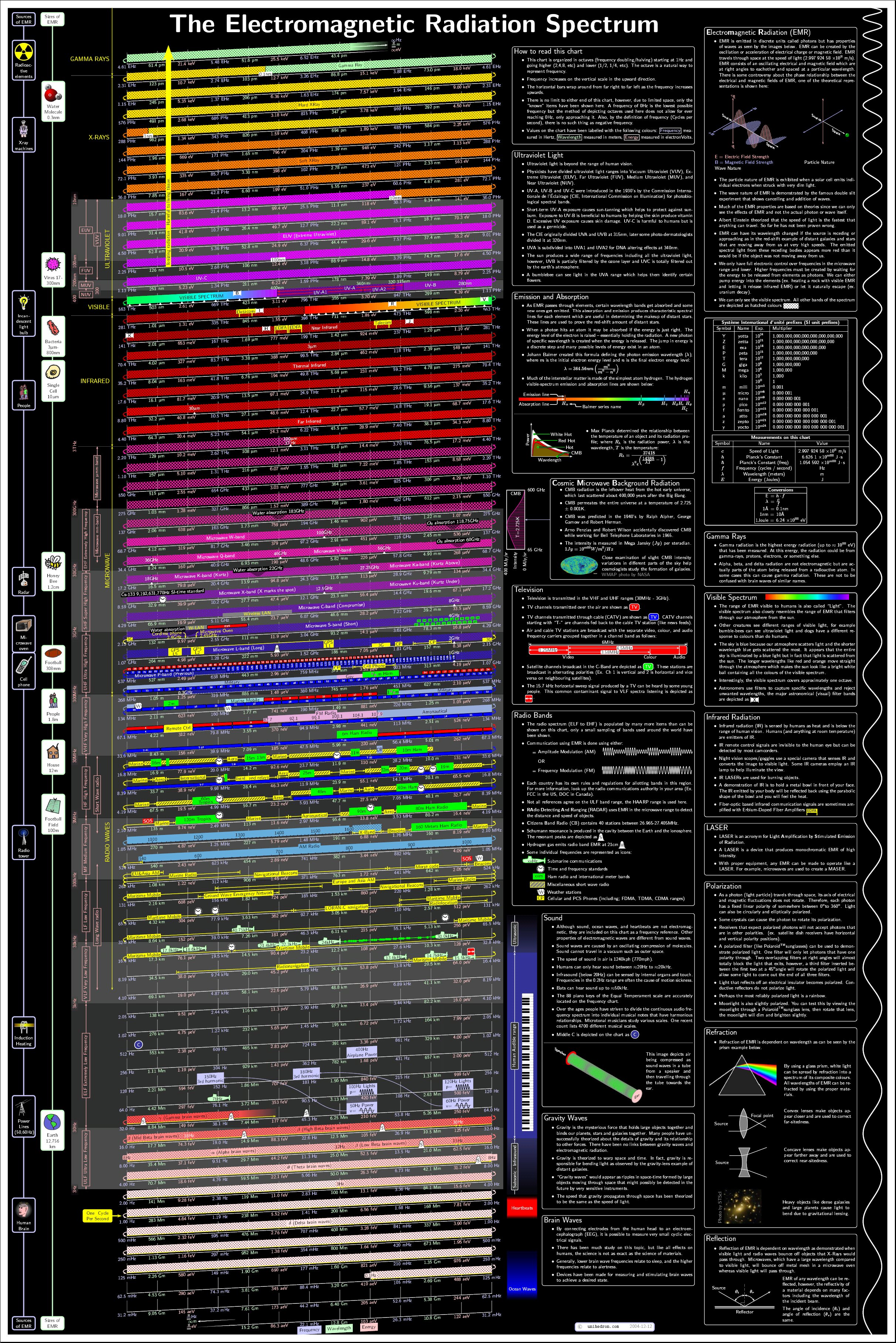
First, the electromagnetic (e/m) waves:
General breakdown of e/m waves from low frequency (and long wavelength) to high frequency (and short wavelength):
Radio
Microwave
IR (infrared)
Visible (ROYGBV)
UV (ultraviolet)
X-rays
Gamma rays
In detail, particularly the last image:
http://www.unihedron.com/projects/spectrum/downloads/full_spectrum.jpg
Mechanical waves include: sound, water, earthquakes, strings (guitar, piano, etc.)....
Mechanical waves include: sound, water, earthquakes, strings (guitar, piano, etc.)....
Again, don't forget that the primary wave variables are related by the expression:
v = f l
speed = frequency x wavelength
(Note that 'l' should be the Greek symbol 'lambda', if it does not already show up as such.)
For e/m waves, the speed is the speed of light, so the expression becomes:
c = f l
Note that for a given medium (constant speed), as the frequency increases, the wavelength decreases.
Next up - Sound!
Tuesday, October 7, 2014
Labbage!
The purpose of today's lab is to determine mathematical relationships regarding harmonics on a string. You will vary the frequency (number of string vibrations per second) and see exactly the wave forms change.
Brief procedure:
1. Set up string and oscillator. Record length of string from pulley to point where it is tied to oscillator.
2. Find the lowest frequency that produces an n=1 harmonic ("one hump"). Record this frequency.
3. Find the next series of frequencies that produce harmonics. Record the harmonic number, frequency, and wavelength. Repeat for several harmonics.
4. Repeat the trials with a different weight on the end - this is effectively changing the tension in the string.
Calculations:
Determine the speed of the wave for each trial, using the expression: speed = frequency x wavelength. The speed values should be in the data table.
The data table should have: harmonic number (n), frequency, wavelength, speed, mass.
Include a graph of frequency vs. harmonic number (for at least one of the runs).
In your conclusion, discuss the mathematical relationships you've found. For example, how are frequency and harmonic number related? How does tension affect the frequency?
Also include sources of error for this experiment.
Basic structure of the lab report:
Title
Purpose of lab
Data table
Sample calculation for speed (your data table will have ALL of the calculated values, but there is only need for one calculation to be shown)
Graph(s)
Conclusion - probably the biggest, most detailed part of the lab
Subscribe to:
Posts (Atom)