Tuesday, December 16, 2014

Test practice

Consider 700 nm light ray, hitting a block of plastic at 40 degrees.  It refracts to an angle of 25 degrees.  Find:

- Index of refraction of plastic
- speed of light inside plastic
- wavelength inside plastic
- frequency of light

Consider a lens, focal length of -20 cm. An object is 30 cm in front of it.  Find:

- Image location
- type of image
- magnification of image

Wednesday, December 10, 2014

To play with.....

http://phet.colorado.edu/sims/geometric-optics/geometric-optics_en.html

Move the object to see how the image formation changes.  Choosing "principal rays" makes it easiest to see things.

Feel free to play around with the other options.

Monday, December 8, 2014

Reminder about formulas for the lab

Thin Len (or Mirror) Equation:

1/f  =  1/di  +  1/do

Remember:  it's quickest to use the x^-1 key on your calculator (4th key down on the left on most calculators).


Percent error = [(experimental - theoretical)/theoretical] * 100

Or if you prefer:

[ (exp - theo) / theo ] * 100

In our experiment, the calculated f (using the thin lens equation) is "experimental".  The "theoretical" value is the one that was printed on the lens or mirror.  (The mirror focal lengths were all 20 cm, except for the one that was 22 cm.)

You'll need to calculate the experimental focal lengths for EACH trial where you have numerical do and di data.  Do these calculations before the next class and add them to your data table (along with the percent error).

Lab guidelines

Basic structure of the lab report:

* Title

* Purpose of lab

* Your hypothesis (from the earlier homework)

* Data table - include all columns from your data, AND 2 more columns:  calculated f, and percent error
   - be sure to calculate these for all trials where you have numerical data for real images

* Sample calculation for focal length (your data table will have ALL of the calculated values, but there is only need for one calculation to be shown)

* Graph(s) if you made any (they are not required, but a graph of di versus do might be instructive)

* Conclusion - probably the biggest, most detailed part of the lab:
 - Address your hypothesis.
 - Give sources of error.
 - Discuss how the image formation depends on object distance.  Note if there "transition points", etc.  This is the tough part of the conclusion (and the most mathematical).
 - Give a general conclusion.

Thursday, December 4, 2014

HW for Monday

Look at your lab data - note trends, if you can see any.  Things like:  does the images become virtual at a certain point, does the image go from smaller to bigger at a certain point, etc.

In your conclusion, one thing you will address will be:  how well do your results match your prediction/hypothesis?

Look up the "thin lens equation."  It will have the variables:  di, do, and f.

Thanks!

Tuesday, December 2, 2014

HW for Thursday

Find a formal definition for "focal point" and/or "focal length" of a lens.  Does this apply to all lenses (convex and concave)?

Also, if you are unclear about real and virtual images, do a little research about this, too.

As always, this site is helpful:

http://www.physicsclassroom.com/

And now, the lab:

On Thursday we will begin a new formal lab.  This lab is all about convex and concave lenses and mirrors.  You have played with lenses and mirrors a bit in class.  For our next class, please write a formal hypothesis for this experiment.  It will likely be informed by what you saw today in class.  The hypothesis should address the following:

How will the distance between object and lens affect whether or not an image is formed, how (relatively) large the image is (bigger/smaller) and whether or not the image is right-side up or upside-down?  Also, address what types of optics (concave or convex lenses and mirrors) will produce images (real or virtual).

FYI - a "real" image can be projected onto a screen (think of setting fire with a magnifying glass), whereas "virtual" images are only seen "inside" lenses or mirrors (think of looking at yourself in a bathroom mirror).

Answers may be something like:

- I believe that all images will form at the focal point, and I think that all images will be real and smaller than the object.
- I believe that images will only form if the object is very close, but that these images will be virtual.
- I believe that images will be formed only when the object is between the theoretical focal point and twice the theoretical focal point, and that these real images will always be smaller than the object.
- etc.

Be sure to type out your hypothesis and keep a copy for your formal lab report - I will be checking these at the beginning of class.

Monday, December 1, 2014

For next class (if you see this in time)

Please look up the definition of "focal point" and/or "focal length."

Also look up the definitions of "real image" and "virtual image."

Thanks!  Sorry for the late notice.  If you don't have time to do this, it'll be ok.

sean

Friday, November 21, 2014

Quiz review - what to expect

1.  Doppler effect
- use of the formula (be sure to understand 't a t a')
- understanding what it means
- red shift, blue shift

2.  Use of trig - Be sure that you can solve for things like:
- sin 20
- finding angle when you know the sine - for example, what is theta when sin(theta) = 0.75

3.  Snell's law and refraction

n = c/v

v = frequency x wavelength

n1 sin (theta 1) = n2 sin (theta 2)

There are two other versions of Snell's law, but you don't actually have to use them - in fact, if you are confused by all the formulas, just forget that those exist and use only the 3 above.

4.  Being able to draw the refracted path when light goes from one medium to another.

SAMPLE PROBLEM:

Light (wavelength 585 nm) goes from air to a new material.  Angle of incidence is 40 degrees and the angle inside the material is 20 degrees.  Both angles are measured with respect to the normal/perpendicular line.  Find the following:

a.  index of refraction of material
b.  speed of light inside material
c.  frequency of light
d.  wavelength of light inside material

Monday, November 17, 2014

HW for Wednesday

Trig practice (if you need/want it):

1.  Find:  

sin 0
sin 30
sin 45
sin 60
sin 90

2.  Find the angle with these sine values:

0.1
0.3
0.75
1

Snell's law

3.  A red light (632 nm = 632 x 10^-9 m) hits a block of glass (n = 1.5) at an angle of 30-degrees (with respect to a normal line).  Draw a picture to represent this, and then find the following:

a.  the angle of refraction inside the glass
b.  the speed of light outside the glass
c.  the speed of light inside the glass
d.  the frequency of light outside/inside the glass
e.  the wavelength of light inside the glass

4.  Draw three parallel lines hitting the side of and refracting these optics:

a.  convex lens (thicker in the middle)
b.  concave lens (thinner in the middle)

5.  Write down anything that still confuses you.


Friday, November 14, 2014

For Monday

Look up definitions of:

Index of refraction

Snell's law

We will do a little trig as well - SOH CAH TOA - have you seen that before?

Tuesday, November 11, 2014

HW for Thursday

Review your notes from the ripple tank lab. 

Next, find some definitions for:

reflection
refraction
diffraction
interference

Consider these in light of your experiment notes/drawings - how do these definitions match what you saw?  What was happening in your experiment. 

Please write down answers - I will be checking these in our next class.

Friday, November 7, 2014

Doppler problem

An ambulance traveling at 25 m/s has a siren that normally blasts a 1000 Hz tone.  Find the frequency you hear when:

A.  The  ambulance approaches you
B.  the ambulance rives past you
C.  The ambulance approaches you while you run toward it at 5 m/s
D.  The ambulance has past you while you are running away from it at 5 m/s

Doppler Effect!

http://www.lon-capa.org/~mmp/applist/doppler/d.htm

http://falstad.com/mathphysics.html
Run the Ripple tank applet -
http://falstad.com/ripple/

The key in the Doppler effect is that motion makes the "detected" or "perceived" frequencies higher or lower.

If the source is moving toward you, you detect/measure a higher frequency - this is called a BLUE SHIFT.

If the source is moving away from you, you detect/measure a lower frequency - this is called a RED SHIFT. Distant galaxies in the universe are moving away from us, as determined by their red shifts. This indicates that the universe is indeed expanding (first shown by E. Hubble). The 2011 Nobel Prize in Physics went to local physicist Adam Riess (and 2 others) for the discovery of the accelerating expansion of the universe. Awesome stuff!

http://www.nobelprize.org/nobel_prizes/physics/laureates/2011/

It's worth noting that the effect also works in reverse. If you (the detector) move toward a sound-emitter, you'll detect a higher frequency. If you move away from a detector move away from a sound-emitter, you'll detect a lower frequency.

Mind you, these Doppler effects only happen WHILE there is relative motion between source and detector (you).

And they also work for light. In fact, the terms red shift and blue shift refer mainly to light (or other electromagnetic) phenomena.

Wednesday, November 5, 2014

HW for Friday

Read up about the Doppler effect for our next class.  Take notes.

Monday, October 27, 2014

Test prep

Waves:
- mechanical
- electromagnetic

Further division of wave type:
- transverse
- longitudinal (compressional)

wave equation:
speed (v) = frequency (f) x wavelength (lambda)

Harmonics on a string:
- wavelength = 2L/n
- drawing waveforms
- calculating frequencies and speeds
- knowing that the frequencies go up linearly

Harmonics in a tube:
- same as above, but remember that there are antinodes on both ends (NOT nodes)
- if tube is open on ONE end only, lowest harmonic is one octave lower than if tube is open on both ends
- use speed of sound as your wave speed

Music stuff:
- octave (double frequency)
- go up a semi-tone (guitar fret, piano key, etc.), multiply by 1.0595 (twelfth root of 2)


Thursday, October 23, 2014

More practice

1.  Middle C is 261.6 Hz.  Find the following:

a.  the next two C's above this note (one and two octaves above)
b.  the C one octave below middle C
c.  C#, which is one semi-tone (or piano key or guitar fret) above C
d.  D, which is two semi-tones above C
e.  The wavelength of middle C, if the speed of sound is 340 m/s

(You will probably not be able to do c-e until the next class.)

2.  Find the frequency associated with a blue LED (450 nm).

3.  Recall the demonstrations with Chladni plates and the Ruben's (fire) tube.  Make sure you understand them.

4.  Review the work from the informal lab and write out explanations where asked.

Saturday, October 18, 2014

practice problems

1.  Differentiate between mechanical and electromagnetic waves.  Give examples.

2.  Draw a wave and identify the primary parts (wavelength, crest, trough, amplitude).

3.  Find the speed of a 500 Hz wave with a wavelength of 0.4 m.

4.  What is the frequency of a wave that travels at 24 m/s, if 3 full waves fit in a 12-m space?  (Hint:  find the wavelength first.)

5.  Approximately how much greater is the speed of light than the speed of sound?

6.  Harmonics

a.  Draw the first 3 harmonics for a wave on a string.
b.  If the length of the string is 1-m, find the wavelengths of these harmonics.
c.  If the frequency of the first harmonic (n = 1) is 10 Hz, find the frequencies of the next 2 harmonics.
d.  Find the speeds of the 3 harmonics.  

7.  Compute the wavelength of the radio signal 107.9.  Note that MHz means 'million Hz."

8.  A C-note vibrates at 262 Hz (approximately).  Find the frequencies of the next 2 C's (1 and 2 octaves above this one).

9.  A red LED has a wavelength of 662 nm.  What is the frequency of light emitted from it?

Monday, October 13, 2014

HW

Don't forget your lab draft on Wednesday.

Also, try these problems - mostly as practice with scientific notation and your calculator.

1.  What is the wavelength of the radio station 97.9 ("98 Rock").  Keep in mind that the number refers to the frequency in MHz.

2.  The visible range of human eyesight is 700 nm to 400 nm.  What are the frequencies associated with this, and which end is red and which is violet?

Friday, October 10, 2014

Wave notes FYI. Keep working on lab (draft due Wednesday)


So - Waves.....  

We spoke about energy.  Energy can, as it turns out, travel in waves.  In fact, you can think of a wave as a traveling disturbance, capable of carrying energy.

There are several wave characteristics (applicable to most conventional waves) that are useful to know:

amplitude - the "height" of the wave, from equilibrium (or direction axis of travel) to maximum position above or below

crest - peak (or highest point) of a wave

trough - valley (or lowest point) of a wave

wavelength (lambda - see picture 2 above) - the length of a complete wave, measured from crest to crest or trough to trough (or distance between any two points that are in phase - see picture 2 above).  Measured in meters (or any units of length).

frequency (f) - literally, the number of complete waves per second.  The unit is the cycle per second, usually called:  hertz (Hz)

wave speed (v) -  the rate at which the wave travels.  Same as regular speed/velocity, and measured in units of m/s (or any unit of velocity).  It can be calculated using a simple expression:


There are 2 primary categories of waves:

Mechanical – these require a medium (e.g., sound, guitar strings, water, etc.)

Electromagnetic – these do NOT require a medium and, in fact, travel fastest where is there is nothing in the way (a vacuum). All e/m waves travel at the same speed in a vacuum (c, the speed of light):

c = 3 x 10^8 m/s

First, the electromagnetic (e/m) waves:

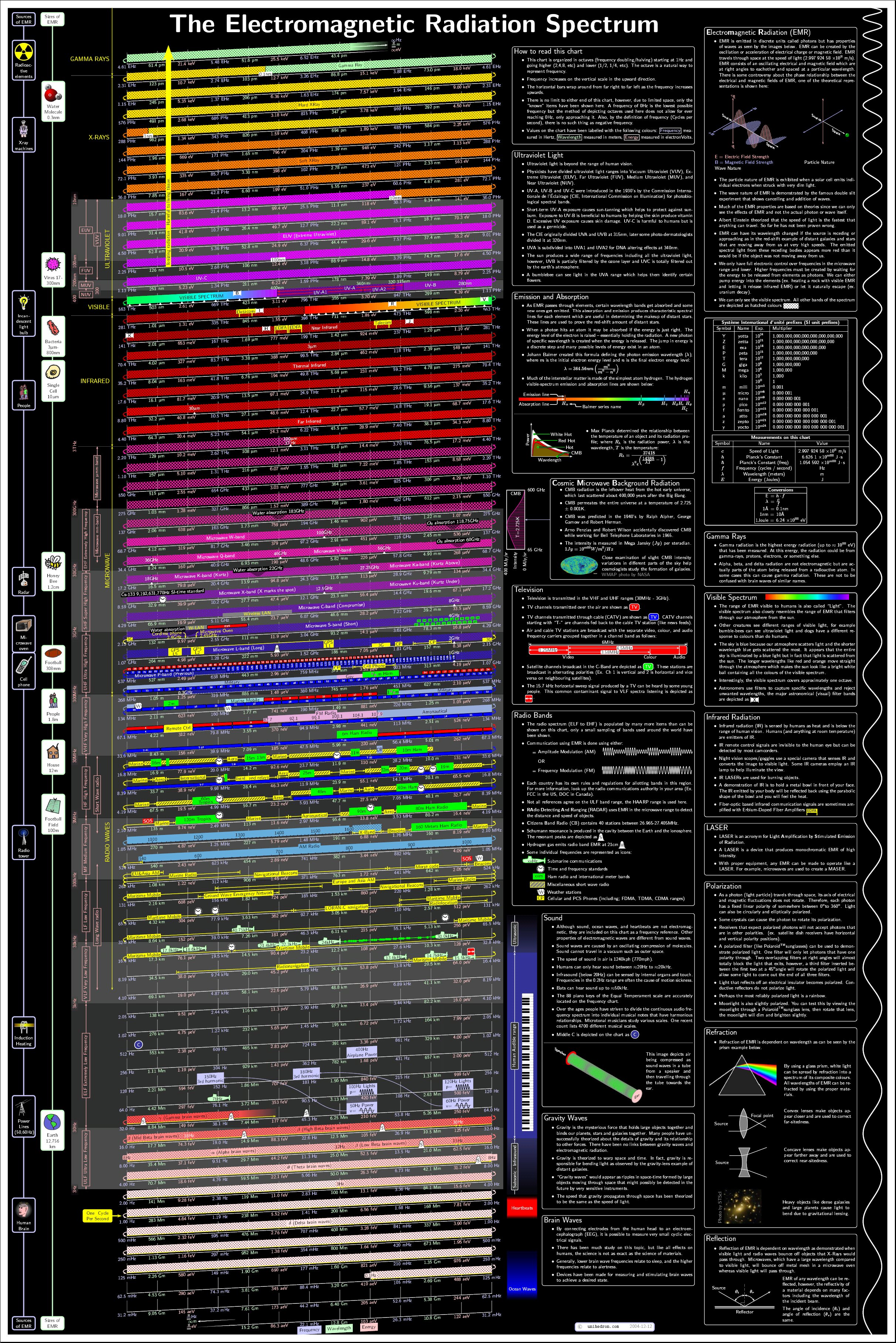
General breakdown of e/m waves from low frequency (and long wavelength) to high frequency (and short wavelength):

Radio
Microwave
IR (infrared)
Visible (ROYGBV)
UV (ultraviolet)
X-rays
Gamma rays

In detail, particularly the last image:


http://www.unihedron.com/projects/spectrum/downloads/full_spectrum.jpg

Mechanical waves include:  sound, water, earthquakes, strings (guitar, piano, etc.)....

Again, don't forget that the primary wave variables are related by the expression:

v = f l


speed = frequency x wavelength

(Note that 'l' should be the Greek symbol 'lambda', if it does not already show up as such.)

For e/m waves, the speed is the speed of light, so the expression becomes:

c = f l


Note that for a given medium (constant speed), as the frequency increases, the wavelength decreases.

Next up - Sound!

Tuesday, October 7, 2014

Labbage!

The purpose of today's lab is to determine mathematical relationships regarding harmonics on a string.  You will vary the frequency (number of string vibrations per second) and see exactly the wave forms change.

Brief procedure:

1.  Set up string and oscillator.  Record length of string from pulley to point where it is tied to oscillator.
2.  Find the lowest frequency that produces an n=1 harmonic ("one hump").  Record this frequency.
3.  Find the next series of frequencies that produce harmonics.  Record the harmonic number, frequency, and wavelength.  Repeat for several harmonics.
4.  Repeat the trials with a different weight on the end - this is effectively changing the tension in the string.

Calculations:

Determine the speed of the wave for each trial, using the expression:  speed = frequency x wavelength.  The speed values should be in the data table.

The data table should have:  harmonic number (n), frequency, wavelength, speed, mass.

Include a graph of frequency vs. harmonic number (for at least one of the runs).

In your conclusion, discuss the mathematical relationships you've found.  For example, how are frequency and harmonic number related?  How does tension affect the frequency?

Also include sources of error for this experiment.

Basic structure of the lab report:

Title
Purpose of lab
Data table
Sample calculation for speed (your data table will have ALL of the calculated values, but there is only need for one calculation to be shown)
Graph(s)


Conclusion - probably the biggest, most detailed part of the lab

Monday, September 29, 2014

quiz

period of pendulum (equation)
motion of the pendulum, in general
SI units - what are the standards based on

Study the first submitted homework assignment.

Wednesday, September 24, 2014

HW

Come to class with a definition of these things:

- wave
- amplitude
- frequency
- sine wave - this may be beyond where you are mathematically at the moment, so don't panic if you don't get it.

What do you see as the connection between the motion of a pendulum - what we call "simple harmonic motion" - and the motion of a wave?

Monday, September 22, 2014

HW for Wednesday

Check out the list of humorous units (for fun!):

http://en.wikipedia.org/wiki/List_of_humorous_units_of_measurement

In this spirit, create your own unit(s).

Also - we didn't chat about the blog postings.  Sorry about that!  Bring thoughts or questions you may have (if any).

You may want to see the list of SI prefixes:

http://en.wikipedia.org/wiki/Metric_prefix

Finally.  Determine the length of a milliday (in units that make sense).  How does a milliyear compare to normal class period?


Thursday, September 18, 2014

Read for HW

Read my old blog posts for homework.  Write down anything you find interesting, or any questions you may have.

http://howdoweknowthat.blogspot.com/2009/07/how-do-we-know-that-earth-is-spherical.html

http://howdoweknowthat.blogspot.com/2009/07/so-how-big-is-earth.html


And if you have time:

http://howdoweknowthat.blogspot.com/2009/07/how-far-away-is-that.html

Tuesday, September 16, 2014

Homework questions to turn in Thursday

Please finish these questions/problems - try them all - and be prepared to turn this in to me in class on Thursday.

1.  What is a "simple pendulum"?  What makes a simple pendulum "simple" or why do we call it simple?

2.  Calculate the period of a simple pendulum with a 0.5-m long length:
a.  on Earth
b.  on the Moon, where g = 1.7 m/s/s

3.  The acceleration due to gravity on Jupiter is about 2.5 times greater than that of Earth.  Without calculating, how would the period of a pendulum be different on Jupiter (compared to Earth)?

4.  Draw the approximate shape of the graph for period vs. length of a pendulum.

5.  A little bit of algebra may be required - try this, even if algebra isn't your strongest skill.  You want a pendulum to swing with a period of 2 seconds.  How long must it be?

6.  What is the current standard of the meter based on?


Monday, September 15, 2014

HW

Yikes - forgot to update this with the homework for tomorrow:

Look up the equation/relationship for the period of a simple pendulum.

Describe how the equation works; the variables involved, etc.

Thursday, September 11, 2014

Try this instead...

There is some problem downloading Logger Pro.  I guess the password has been changed and I'm not sure what the new one is.

Try the demo version for now:

http://www.vernier.com/downloads/logger-pro-demo/

Wednesday, September 10, 2014

HW for Friday

If you have a computer at home, please download LoggerPro - a software package site-licensed to Park School:

https://parkscience.pbworks.com/w/page/351271/LoggerPro

Run the installer.  When prompted for a password, type:  ecosystem


Open the software and play around with it.  Using your data for period (in seconds) vs. length (in cm, or whatever unit you used), plot it.

You may need to "autoscale" the graph -- to make it fit nicely.  Do this by right-clicking and choosing autoscale (twice).  On a Mac, right click is a two-finger tap on the keypad or CTRL-click.

If you are feeling ambitious, try a "curve fit" under the analyze heading.

Print out your period vs. length graph.

Tuesday, September 9, 2014

Set up for lab

In our laboratory experiment, we will determine a physical relationship:  what factors affect the motion/time of a pendulum.

We determined in class that the length of a pendulum seems to matter most - it seemed to have the greatest effect on the time for one complete swing of a pendulum (also known as the period).  Angle mattered a little, but mostly if you were at an angle greater than 15 degrees (with respect to vertical).

For next class, prepare a data table for many trials.  You'll be measuring time/period vs. length.  In your data table, decide:  the units for each column, whether or not you're timing one swing or multiple swings (and have a separate column for a single swing), enough space for 20 different lengths (and maybe multiple trials of each), etc.  Also, prepare a short statement that describes your technique for measuring the time of swing (period).

Ultimately, you will produce a graph that suggests the relationship (if there is one to be found).

Friday, September 5, 2014

Pseudoscience reading

What Is Pseudoscience?
Distinguishing between science and pseudoscience is problematic

By Michael Shermer

Climate deniers are accused of practicing pseudoscience, as are intelligent design creationists, astrologers, UFOlogists, parapsychologists, practitioners of alternative medicine, and often anyone who strays far from the scientific mainstream. The boundary problem between science and pseudoscience, in fact, is notoriously fraught with definitional disagreements because the categories are too broad and fuzzy on the edges, and the term “pseudoscience” is subject to adjectival abuse against any claim one happens to dislike for any reason. In his 2010 book Nonsense on Stilts (University of Chicago Press), philosopher of science Massimo Pigliucci concedes that there is “no litmus test,” because “the boundaries separating science, nonscience, and pseudoscience are much fuzzier and more permeable than Popper (or, for that matter, most scientists) would have us believe.”

It was Karl Popper who first identified what he called “the demarcation problem” of finding a criterion to distinguish between empirical science, such as the successful 1919 test of Einstein’s general theory of relativity, and pseudoscience, such as Freud’s theories, whose adherents sought only confirming evidence while ignoring disconfirming cases. Einstein’s theory might have been falsified had solar-eclipse data not shown the requisite deflection of starlight bent by the sun’s gravitational field. Freud’s theories, however, could never be disproved, because there was no testable hypothesis open to refutability. Thus, Popper famously declared “falsifiability” as the ultimate criterion of demarcation.

The problem is that many sciences are nonfalsifiable, such as string theory, the neuroscience surrounding consciousness, grand economic models and the extraterrestrial hypothesis. On the last, short of searching every planet around every star in every galaxy in the cosmos, can we ever say with certainty that E.T.s do not exist?

Princeton University historian of science Michael D. Gordin adds in his forthcoming book The Pseudoscience Wars (University of Chicago Press, 2012), “No one in the history of the world has ever self-identified as a pseudoscientist. There is no person who wakes up in the morning and thinks to himself, ‘I’ll just head into my pseudolaboratory and perform some pseudoexperiments to try to confirm my pseudotheories with pseudofacts.’” As Gordin documents with detailed examples, “individual scientists (as distinct from the monolithic ‘scientific community’) designate a doctrine a ‘pseudoscience’ only when they perceive themselves to be threatened—not necessarily by the new ideas themselves, but by what those ideas represent about the authority of science, science’s access to resources, or some other broader social trend. If one is not threatened, there is no need to lash out at the perceived pseudoscience; instead, one continues with one’s work and happily ignores the cranks.”

I call creationism “pseudoscience” not because its proponents are doing bad science—they are not doing science at all—but because they threaten science education in America, they breach the wall separating church and state, and they confuse the public about the nature of evolutionary theory and how science is conducted.

Here, perhaps, is a practical criterion for resolving the demarcation problem: the conduct of scientists as reflected in the pragmatic usefulness of an idea. That is, does the revolutionary new idea generate any interest on the part of working scientists for adoption in their research programs, produce any new lines of research, lead to any new discoveries, or influence any existing hypotheses, models, paradigms or world­views? If not, chances are it is pseudoscience.

We can demarcate science from pseudoscience less by what science is and more by what scientists do. Science is a set of methods aimed at testing hypotheses and building theories. If a community of scientists actively adopts a new idea and if that idea then spreads through the field and is incorporated into research that produces useful knowledge reflected in presentations, publications, and especially new lines of inquiry and research, chances are it is science.

>


http://www.randi.org/site/index.php/encyclopedia.html

http://www.quackwatch.com/01QuackeryRelatedTopics/pseudo.html

http://en.wikipedia.org/wiki/Pseudoscience

http://www.skepdic.com/pseudosc.html

>

Also keep in mind sites like:

snopes.com
http://www.straightdope.com/


>


Alien Autopsy film - when you watch it, consider what makes it believable or NOT believable.
If you ever have an hour to kill - the definitive documentary on pseudoscience and psychic stuff, in general.